
May
Transporting rendering machines and screed pumps safely is an essential part of site preparation, yet it is often overlooked. Whether you are moving a compact render spray machine like a DropPro 8P or a larger screed pump, poor loading practices can lead to damaged equipment, unsafe driving conditions, and even serious injury.
At CES Hire, we know how important it is to protect both your machine and your team. Proper loading ensures your equipment arrives on site safely, performs as expected, and avoids costly downtime.
Here are our best practices for safely loading rendering machines into vans and trucks.

1. Make Sure Your Vehicle Is Suitable
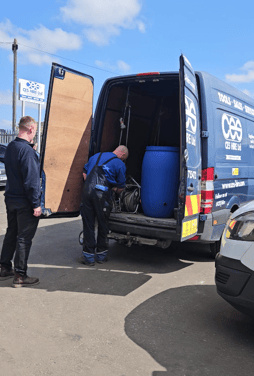 Before loading any machine, always check that your van or truck is large enough and rated to carry the weight safely.
Rendering machines come in all shapes and sizes, and weight can vary significantly depending on the type of machine. A lightweight grout pump may fit easily into a small van, while a larger render machine or screed pump may require a larger commercial vehicle.
Always check:
- Machine dimensions (height, width, and length)
- Total machine weight
- Vehicle payload limits
- Access height for loading
- Available loading equipment
Trying to force a machine into an unsuitable vehicle can damage both the machine and the van—and create serious safety risks.
2. Use the Right Loading Method
The safest loading method depends entirely on the size and weight of the machine.
Ask yourself:
- Can the machine be lifted safely by hand?
- Will you need heavy-duty loading ramps?
- Is a winch required?
- Do you need mechanical lifting equipment?
Never guess the weight. Always confirm before attempting to move the machine.
For heavier machines, ramps or a winch are often the safest option. For smaller units, team lifting may be suitable but only if done correctly.
3. Choose Safe, Heavy-Duty Ramps
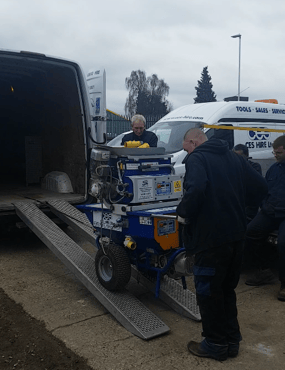 If using ramps, they must be suitable for the weight of the machine.
We recommend:
- Heavy-duty ramps rated for at least 250–400kg minimum
- Non-slip surfaces for better grip
- Raised sides for additional safety
- Secure fixing points to prevent movement
Before loading, ensure the ramps are properly positioned and firmly secured to the van or truck. Loose or unstable ramps are one of the biggest causes of loading accidents.
Never use lightweight domestic ramps for heavy construction equipment.
4. Control the Machine When Unloading
Unloading can often be more dangerous than loading—especially with wheeled machines.
When moving a machine down a ramp, gravity can quickly take over, causing the machine to move faster than expected. This is particularly risky with screed pumps and render machines fitted with wheels.
Always:
- Keep both hands on the machine
- Move slowly and steadily
- Have a second person assisting where possible
- Never stand directly in front of the machine
- Keep the machine under full control at all times
Losing control on a ramp can cause major injury and expensive damage.
5. Lift Safely When Manual Handling
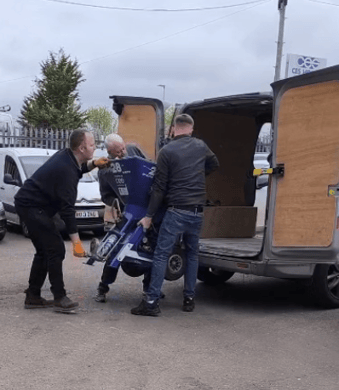 If the machine can be lifted manually, never attempt this alone.
Always have at least one other person helping, and consider the total machine weight before lifting. Some machines may look manageable but are far heavier than expected.
Use proper lifting technique:
- Bend your knees, not your back
- Keep your back straight
- Lift with your legs
- Hold the machine at strong anchor points
- Avoid lifting by hoses, handles, or weak attachments
Poor lifting technique is one of the most common causes of workplace injuries.
6. Position the Machine Correctly Inside the Vehicle
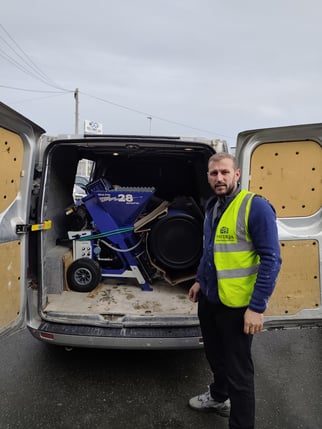 Once loaded, the machine should be placed as close to the bulkhead (front wall of the van) as possible.
This improves weight distribution and makes transport significantly safer.
Why?
Keeping the load closer to the front axle helps:
- Improve vehicle stability
- Reduce movement during braking
- Prevent rear axle overloading
- Improve handling on the road
- Reduce the risk of load shift during transport
Machines placed too far back can make steering unstable and increase stopping distances.
As a general rule: centre the load and keep it forward.
7. Keep the Machine Upright Wherever possible, always transport rendering machines upright.
Many machines contain:
- Oil
- Fuel
- Hydraulic fluids
- Residual water
- Internal moving components
Laying a machine on its side can cause leaks, internal damage, and expensive repair issues. Oil spills inside vans are also difficult and costly to clean.
Always check manufacturer guidance if transporting a machine in anything other than its normal upright position.
8. Secure with Ratchet Straps Properly
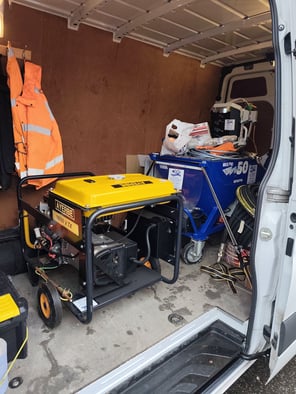 One of the biggest mistakes people make is not securing machines properly.
Always use heavy-duty ratchet straps to prevent movement during transport.
Best practice includes:
- Strap directly to the machine chassis
- Never strap over hoses, pipes, or controls
- Use multiple securing points
- Check straps are tight and stable
- Avoid overtightening fragile components
Strapping over hoses or fittings can crush them and cause expensive damage before you even arrive on site.
A machine that moves in transit is a serious hazard.
9. Prepare the Machine Before Transport
 Before loading, take a few minutes to prepare the machine properly.
This includes:
Empty the Hopper
Never travel with material left inside the hopper.
Movement during transport can compact the material, making it harder to remove later and potentially causing blockages or cleaning issues.
Disconnect Power Supplies
Unplug generators and electrical supplies before transport.
This prevents accidental damage to cables and connectors.
Remove Detachable Parts
Take off:
- Hoses
- Spray guns
- Accessories
- Loose fittings
These should be stored separately and securely.
Lock Wheels
If the machine is fitted with wheels, ensure they are locked before transport.
Secure Loose Parts
Nothing should be left loose inside the van.
Loose parts can:
- Damage the machine
- Damage the vehicle
- Become dangerous projectiles during braking
A few extra minutes of preparation can prevent major repair costs later.
Final Thoughts
Safe loading is not just about protecting your rendering machine; it is about protecting your team, your vehicle, and your project timeline.
At CES Hire, we always recommend taking the time to load equipment properly rather than rushing and risking damage or injury.
The right ramps, proper lifting techniques, correct positioning, and secure strapping all make a huge difference.
Because when your machine arrives safely, your job starts smoothly.
If you need advice on transporting render machines, screed pumps, or selecting the right equipment for your next project, the CES Hire team is always here to help.
