---
title: Top Tips For Spraying Monocouche Render Like A Professional
description: Master the art of spraying monocouche render with our expert tips on mix consistency, application technique, and achieving a professional finish.
image: https://blog.ces-hire.com/hubfs/CES%20Hire%20Blog%20Top%20Tips%20for%20Monocouche-1.png
---
**Mainland UK Delivery**
**Try Before You Buy** Learn more
[01494 977428](tel:01494%20977428) [Customer Help](https://www.ces-hire.com/pages/contact-us)
[](https://ces-hire.myshopify.com/)
Reset
- [Shop](https://ces-hire.myshopify.com/collections)
- [Machinery](https://ces-hire.myshopify.com/collections)
- [Plastering & Render Machines](https://www.ces-hire.com/collections/machinery-plastering-and-rendering-machines)
- [Screed Pumps](https://www.ces-hire.com/collections/machinery-screed-pumps)
- [Compressor Kits](https://www.ces-hire.com/collections/compressor-kits)
- [Mixers](https://www.ces-hire.com/collections/machinery-mixers)
- [Grout Pumps](https://www.ces-hire.com/collections/machinery-grout-pumps)
- [Compressors](https://www.ces-hire.com/collections/machinery-small-air-compressors)
- [Pressure Washers](https://www.ces-hire.com/collections/machinery-pressure-washers)
- [Paint & Plaster Spray Equipment](https://www.ces-hire.com/collections/machinery-airless-paint-and-plaster-spray-equipment)
- [Resin Injection Pumps](https://www.ces-hire.com/collections/machinery-resin-injection-pumps)
- [Transformers & Generators](https://www.ces-hire.com/collections/machinery-transformers-and-generators)
- [Used & Refurbished](https://www.ces-hire.com/collections/offers-and-clearance-used-and-refurbished-plant)
- [Power Tools](https://ces-hire.myshopify.com/collections)
- [Plastering & Rendering Power Tools](https://www.ces-hire.com/collections/power-tools-for-plastering-and-rendering-power-tools)
- [Concrete Power Tools](https://www.ces-hire.com/collections/power-tools-for-concrete-power-tools)
- [Pressure Washers](https://www.ces-hire.com/collections/machinery-pressure-washers)
- [Machine Parts & Accessories](https://ces-hire.myshopify.com/collections)
- [Plastering, Grout & Screed Pump Hoses & Couplings](https://www.ces-hire.com/collections/machinery-machine-parts-and-accessories-plastering-and-rendering-spray-machine-and-grout-pump-spare-parts-plastering-machine-and-grout-pump-delivery-hoses-and-couplings)
- [Rotors & Stators](https://www.ces-hire.com/collections/consumables-replacement-rotors-and-stators)
- [Couplings and Fittings](https://www.ces-hire.com/collections/couplings-fittings)
- [Service Kits & Filters](https://www.ces-hire.com/collections/service-kits-filters)
- [Mixing Shafts & Paddles](https://www.ces-hire.com/collections/mixing-shafts-paddles)
- [Water Pumps](https://www.ces-hire.com/collections/water-pumps)
- [Spray Guns & Nozzles](https://www.ces-hire.com/collections/machinery-rendering-plastering-and-fire-protection-spray-guns-spray-guns-and-nozzles)
- [Forced Action Mixer Parts](https://www.ces-hire.com/collections/forced-action-mixer-parts)
- [Transformers](https://www.ces-hire.com/collections/machinery-machine-parts-and-accessories-transformers)
- [All Parts & Accessories](https://www.ces-hire.com/collections/machinery-machine-parts-and-accessories)
- [Consumables](https://ces-hire.myshopify.com/collections)
- [Tapes & Masking Films](https://www.ces-hire.com/collections/consumables-tapes-and-masking-films)
- [Construction Chemicals](https://www.ces-hire.com/collections/consumables-building-sealants-and-chemical-additives)
- [Cleaning Products](https://www.ces-hire.com/collections/cleaning-products)
- [Render Accelerators & Retarders](https://www.ces-hire.com/collections/render-accelerators-retarders)
- [Power Float Discs](https://www.ces-hire.com/collections/consumables-sanding-discs-and-pads)
- [PPE & Workwear](https://www.ces-hire.com/collections/ppe-and-workwear)
- [Hand Tools](https://ces-hire.myshopify.com/collections)
- [Plastering Trowels](https://www.ces-hire.com/collections/plastering-trowels)
- [Spatulas](https://blog.ces-hire.com/pi.postcodes.io/postcodes/ME14%204JR)
- [Bucket Scoops](https://www.ces-hire.com/collections/bucket-scoops)
- [Thin Coat Render Trowels](https://www.ces-hire.com/collections/thin-coat-render-trowels)
- [Rules & Straight Edges](https://www.ces-hire.com/collections/rules-straight-edges)
- [Sponge Floats](https://www.ces-hire.com/collections/sponge-floats)
- [Scratchers & Scarifiers](https://www.ces-hire.com/collections/scratchers-scarifiers)
- [Hawks & Hand Boards](https://www.ces-hire.com/collections/hawks-hand-boards)
- [Plastering Brushes](https://www.ces-hire.com/collections/plastering-brushes)
- [Buckets & Mixing Tubs](https://www.ces-hire.com/collections/buckets-mixing-tubs)
- [Small Tools & Trowels](https://www.ces-hire.com/collections/small-tools-trowels)
- [Bucket & Margin Trowels](https://www.ces-hire.com/collections/bucket-margin-trowels)
- [Cutting Tools](https://www.ces-hire.com/collections/hand-tools-for-cutting-tools)
- [Flooring & Screeding Tools](https://www.ces-hire.com/collections/hand-tools-for-flooring-tools)
- [Measuring and Layout Tools](https://www.ces-hire.com/collections/hand-tools-for-measuring-and-layout-tools)
- [Site Tools & Accessories](https://www.ces-hire.com/collections/hand-tools-for-site-tools-and-accessories)
- [Tiling Tools](https://www.ces-hire.com/collections/hand-tools-for-tiling-tools)
- [All Plastering & Rendering Tools](https://www.ces-hire.com/collections/hand-tools-for-plastering-and-rendering-tools)
- [Special Offers](https://www.ces-hire.com/collections/offers-and-clearance-special-offers)
- [Hire](https://ces-hire.myshopify.com/collections)
- [Plastering & Rendering Machines](https://www.ces-hire.com/collections/hire-machinery-plastering-and-rendering-machines-for-hire)
- [Screed & Grout Pump Hire](https://www.ces-hire.com/collections/hire-machinery-grout-and-mixer-pump-hire)
- [Small Generators & Transformers](https://www.ces-hire.com/collections/hire-machinery-small-generators-and-transformers-for-hire)
- [Airless Paint & Plaster Spray Machines](https://www.ces-hire.com/collections/hire-machinery-airless-spray-machines-for-plaster-and-paint)
- [Forced Action Mixer Hire](https://www.ces-hire.com/collections/hire-machinery-forced-action-mixer-hire)
- [Resin Injection Pump Hire](https://www.ces-hire.com/collections/resin-injection-pump-hire)
- [Fire Protection Spray Machine Hire](https://www.ces-hire.com/collections/fireproofing-spray-machine-hire)
- [View All Hire Fleet](https://www.ces-hire.com/pages/hire)
- [Support](https://ces-hire.myshopify.com/pages/contact)
- [Servicing & Repairs](https://www.ces-hire.com/pages/service)
- [Knowledge Base](https://offers.ces-hire.com/knowledge-base?hs_preview=VgBEsChq-81179967922)
- [Blog](https://blog.ces-hire.com)
- [FAQs](https://www.ces-hire.com/pages/customer-help)
- Delivery & Returns
- [Downloads](https://ces-hire.myshopify.com)
- [Airless Paint Spray Machines Guide](https://offers.ces-hire.com/airless-paint-spray-machines-guide)
- [Trade In Scheme](https://offers.ces-hire.com/trade-in-scheme)
- [About](https://ces-hire.myshopify.com/pages/contact)
- [About CES](https://www.ces-hire.com/pages/about)
- [Meet the Team](https://www.ces-hire.com/pages/meet-the-team)
- Brands We Stock
- [Baron](https://www.ces-hire.com/pages/baron)
- [Bennu](https://www.ces-hire.com/pages/bennu)
- [Eibenstock](https://www.ces-hire.com/pages/eibenstock)
- [Euromair](https://www.ces-hire.com/pages/euromair)
- [Inotec](https://www.ces-hire.com/pages/inotec)
- [Putzmeister](https://www.ces-hire.com/pages/putzmeister)
- [Qtech](https://www.ces-hire.com/pages/q-tech)
- [Refina](https://www.ces-hire.com/pages/refina)
- [Rokamat](https://www.ces-hire.com/pages/rokamat)
- [Tritech](https://www.ces-hire.com/pages/tritech)
- [Finance Options](https://www.ces-hire.com/pages/construction-equipment-finance)
- [Try Before You Buy](https://offers.ces-hire.com/try-before-you-buy)
- [Contact Us](https://www.ces-hire.com/pages/contact-us)
[Talk To An Expert](https://offers.ces-hire.com/talk-to-an-expert)
Est. 1983
**Free Delivery Over £100**
Expert Machinery Support
**Trade Trusted**
###### [Rendering](https://blog.ces-hire.com/tag/rendering)
# Top Tips For Spraying Monocouche Render Like A Professional
Posted on 14th May 2026 by [Jessica](https://blog.ces-hire.com/author/jessica)
[](https://blog.ces-hire.com/top-tips-for-spraying-monocouche-render)
14
May
Getting a consistent, high-quality finish when spraying monocouche render is all about control, preparation and technique. While the material itself is designed to deliver a decorative, through-coloured finish in fewer coats, the application process still requires attention to detail to avoid visible inconsistencies, patchiness or poor adhesion.
At CES Hire, we work with contractors every day using render spray machines on site, and one thing is always clear, the best results come down to getting the basics right. In this guide, we break down the key techniques to help you achieve a professional monocouche finish every time.
[](https://cta-redirect.hubspot.com/cta/redirect/20165488/d9348d78-2891-4330-a3c8-a1ceb6d1a70b)
---
### 1. Get The Mix Consistency Right
One of the most important steps happens before the render even hits the wall ; the mix.
[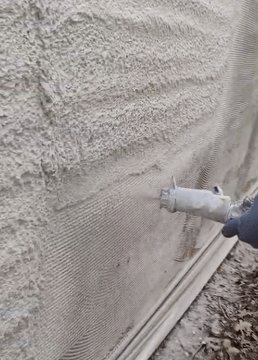](https://ces-hire.com/product-category/plant-machinery/plastering-and-rendering-machines/)Monocouche render must be mixed to the correct consistency to ensure smooth application through the machine and an even finish on the substrate. If the mix is too wet, you risk sagging, slumping and uneven colour drying. If it’s too dry, you’ll struggle with blockages, poor atomisation and a rough finish.
A key factor often overlooked is **environmental conditions**. It’s not just about air temperature — you also need to consider:
- Wall or substrate temperature
- Direct sunlight heating the surface
- Wind exposure and drying speed
A hot wall, for example, can pull moisture from the render far too quickly, affecting both workability and finish quality. Ideally, render should be applied when temperatures are **5°C and rising, but below 30°C**. It’s important not to rely on air temperature alone, always check the substrate temperature as well. Blockwork or rendered surfaces sitting in direct sunlight can easily reach **40°C or more**, even when the outside air temperature seems suitable for application. This excessive heat causes the render to dry too quickly, which can lead to poor adhesion, cracking and an inconsistent finish. In these conditions, lightly misting the surface can help reduce suction and improve workability, but take care not to soak the wall, as too much water can also affect bonding and lead to cracking later on. Always adjust your mix and preparation based on the actual site conditions, not just the weather forecast.
---
### 2. Always Test The Material Before Spraying
Before committing to the wall, always **test your mix through the machine into a bucket**.
[](https://ces-hire.com/product-category/plant-machinery/plastering-and-rendering-machines/)This simple step allows you to check:
- Flow consistency
- Spray pattern
- Material pressure
- Whether the mix is too thick or too thin
It also helps you make quick adjustments before starting the main elevation, saving both time and material waste.
Think of it as your final quality check before production starts on site.
---
### 3. Keep The Spray Gun At 90 Degrees To The Wall
[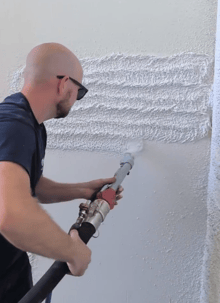](https://ces-hire.com/product-category/plant-machinery/rendering-plastering-fireprotection-spray-guns/spray-guns-and-nozzles/)Maintaining a consistent spray angle is critical for achieving an even finish.
The spray gun should always be held **at 90 degrees to the wall**. Angling the gun can cause uneven build-up, shadowing and inconsistent texture across the surface.
By keeping the gun square to the wall, you ensure:
- Even material distribution
- Consistent texture
- Reduced risk of patching or striping
It also helps the material bond more uniformly to the substrate, improving the overall durability of the finish.
---
### 4. Maintain A Consistent Spray Distance
Distance control is just as important as angle control.
If you move too close to the wall, you’ll get heavy build-up and potential sagging. Too far away, and the material can lose momentum, resulting in dry spray or uneven coverage.
The key is to find a **steady, repeatable distance from the wall and maintain it throughout the application**. This ensures:
- Uniform texture
- Even thickness
- Reduced overspray or material waste
Consistency here is what separates an average finish from a professional one.
---
### 5. Use A Steady, Controlled Movement
[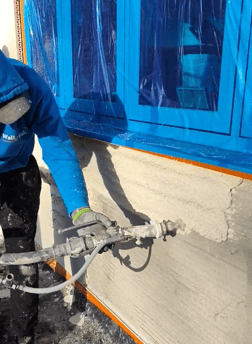](https://ces-hire.com/product-category/plant-machinery/rendering-plastering-fireprotection-spray-guns/spray-guns-and-nozzles/)Spraying monocouche is not about speed; it’s about rhythm and consistency.
A steady hand and controlled movement will help avoid:
- Heavy spots where material builds up
- Thin patches where coverage is insufficient
- Visible inconsistencies across elevations
Work in smooth, overlapping passes and avoid stopping and starting mid-wall wherever possible. If you pause, always feather back into the wet edge to maintain continuity.
Think of it like painting with precision — controlled, not rushed.
---
### 6. Always Start From The Top And Work Downwards
Starting from the top of the wall and working down is a simple but effective technique that improves both finish quality and efficiency.
This approach allows:
- Natural material flow down the surface
- Easier control of overspray and rebound
- A cleaner, more consistent finish
Working upwards can lead to material falling onto freshly finished areas, increasing the risk of contamination and uneven texture.
By working top-down, you stay in control of the application zone at all times.
---
### 7. Ensure Proper Overlap Between Spray Passes
One of the most common causes of visible striping or patchiness is poor overlap between spray lines.
Each pass should slightly overlap the previous one to create a seamless finish. Without this overlap, you risk:
- Visible lines or banding
- Inconsistent texture
- Colour variation once dried
A good rule of thumb is to maintain a light, controlled overlap on each pass while keeping your movement steady and uniform.
It’s a small adjustment that makes a big difference to the final appearance.
---
### Final Thoughts
Spraying monocouche render successfully comes down to discipline and consistency. When you combine the right mix, correct machine setup and controlled spraying technique, you significantly reduce the risk of defects and improve overall finish quality.
To recap, the key principles are:
- Get your mix right and adjust for site conditions
- Always test the material before spraying
- Keep the gun at 90 degrees
- Maintain consistent spray distance
- Use steady, controlled movement
- Work top-down
- Ensure proper overlap between passes
At CES Hire, we don’t just supply rendering equipment , we help contractors get the best out of it. The right technique, combined with the right machine, is what delivers professional results every time.
If you’re looking to improve your spraying setup or want advice on the best machine for monocouche application, our team is always here to help.
[](https://cta-redirect.hubspot.com/cta/redirect/20165488/e9913719-625e-4e29-8a58-057227a31526)
[whatsapp://send?text=Top%20Tips%20For%20Spraying%20Monocouche%20Render%20Like%20A%20Professional%20-%20https://blog.ces-hire.com/top-tips-for-spraying-monocouche-render](whatsapp://send?text=Top%20Tips%20For%20Spraying%20Monocouche%20Render%20Like%20A%20Professional%20-%20https://blog.ces-hire.com/top-tips-for-spraying-monocouche-render) [mailto:enteryour@addresshere.com?subject=Top%20Tips%20For%20Spraying%20Monocouche%20Render%20Like%20A%20Professional&body=Check%20this%20out:%20https://blog.ces-hire.com/top-tips-for-spraying-monocouche-render](mailto:enteryour@addresshere.com?subject=Top%20Tips%20For%20Spraying%20Monocouche%20Render%20Like%20A%20Professional&body=Check%20this%20out:%20https://blog.ces-hire.com/top-tips-for-spraying-monocouche-render)
This entry was posted in [Rendering](https://blog.ces-hire.com/tag/rendering)
##### Jessica
[What Is The Best Paddle Mixer For Construction & Plastering Jobs?](https://blog.ces-hire.com/what-is-the-best-paddle-mixer-for-construction-plastering-jobs)
[How Does A Forced Action Mixer Work In Construction?](https://blog.ces-hire.com/how-does-a-forced-action-mixer-work-in-construction)
Latest Posts
- 01
Oct
[Render & Screed Pump Hoses Explained: Sizes, Types & Best Practice](https://blog.ces-hire.com/render-screed-pump-hoses)
- 24
Sept
[Why Is PPE Important On Construction Sites?](https://blog.ces-hire.com/why-is-ppe-important-on-construction-sites)
- 17
Sept
[How To Achieve The Correct Render Consistency Every Time](https://blog.ces-hire.com/how-to-achieve-the-correct-render-consistency)
- 10
Sept
[How Does A Screed Pump Work?](https://blog.ces-hire.com/how-does-a-screed-pump-work)
- 27
Aug
[Euromair CP100: Meet Our New Electric Liquid Flow Screed Pump](https://blog.ces-hire.com/euromair-cp100-electric-liquid-flow-screed-pump)
Categories
- [Company News](https://blog.ces-hire.com/tag/company-news)
- [Rendering](https://blog.ces-hire.com/tag/rendering)
- [Machine Maintenance](https://blog.ces-hire.com/tag/machine-maintenance)
- [Plastering](https://blog.ces-hire.com/tag/plastering)
- [Events](https://blog.ces-hire.com/tag/events)
- [Toolbox Talks](https://blog.ces-hire.com/tag/toolbox-talks)
- [Screed Pumps](https://blog.ces-hire.com/tag/screed-pumps)
- [Paint Spray Machines](https://blog.ces-hire.com/tag/paint-spray-machines)
- [Latest News](https://blog.ces-hire.com/tag/latest-news)
- [Painter Tapes](https://blog.ces-hire.com/tag/painter-tapes)
Subscribe to our blog
Search
##### Expert Support
Callback within 2 working hours
##### Mainland UK Delivery
Free delivery on orders over £100
##### Est. 1983
Over 40 years supplying trade trusted equipment
##### Try Before You Buy
1 week's hire back towards your purchase price
[](https://ces-hire.myshopify.com/)
## Est. 1983
The UK's specialist in rendering and plastering machinery. Parts, sales and nationwide hire, backed by 40+ years of expertise.
Designed & Developed by [JDR Group](https://www.jdrgroup.co.uk/)
## Company
- [About CES](https://ces-hire.myshopify.com/pages/about)
- [Knowledge Base](https://offers.ces-hire.com/knowledge-base)
- [Delivery Info](https://ces-hire.myshopify.com/pages/customer-help)
- [Returns](https://ces-hire.myshopify.com/pages/customer-help)
- [Contact](https://ces-hire.myshopify.com/pages/contact-us)
## Legal
- [Website T's & C's](https://ces-hire.myshopify.com/pages/terms-conditions)
- [Hire T's & C's](https://ces-hire.myshopify.com/pages/hire-terms-amp-conditions)
- [Privacy Policy](https://ces-hire.myshopify.com/pages/privacy-policy)
- [Cookie Policy](https://ces-hire.myshopify.com/pages/cookie-policy)
- [Equipment Finance](https://ces-hire.myshopify.com/pages/construction-equipment-finance)
## CES Hire Ltd.
Unit F Lincoln Road
Cressex Business Park
High Wycombe
Buckinghamshire
HP12 3RH
Registration Number: 1679280
VAT Number: 370269942
EORI Number: GB370269942000
[youtube icon](https://www.youtube.com/channel/UCsQNF9EuEW3K7JjGCa6DdHA) [instagram icon](https://www.instagram.com/ces_hire/)
- American Express
- Apple Pay
- Diners Club
- Discover
- Google Pay
- Maestro
- Mastercard
- PayPal
- Shop Pay
- Union Pay
- Visa
© 2026 [CES Hire](https://www.ces-hire.com/).
```json
{
"@context" : "https://schema.org",
"@type" : "BlogPosting",
"author" : {
"@type" : "Person",
"name" : "Louisa",
"url" : "https://blog.ces-hire.com/author/louisa"
},
"dateModified" : "2026-05-14",
"datePublished" : "2026-05-14",
"description" : "Master the art of spraying monocouche render with our expert tips on mix consistency, application technique, and achieving a professional finish.",
"headline" : "Top Tips For Spraying Monocouche Render Like A Professional",
"image" : "https://blog.ces-hire.com/hubfs/CES%20Hire%20Blog%20Top%20Tips%20for%20Monocouche-1.png",
"mainEntityOfPage" : {
"@id" : "https://blog.ces-hire.com/top-tips-for-spraying-monocouche-render",
"@type" : "WebPage"
},
"publisher" : {
"@type" : "Organization",
"logo" : {
"@type" : "ImageObject",
"url" : "https://ces-hire.com/wp-content/uploads/logos/CES-Hire-logo.png"
},
"name" : "CES Hire Ltd"
}
}
```